

A strategic importer deal that says far more than the headline suggests
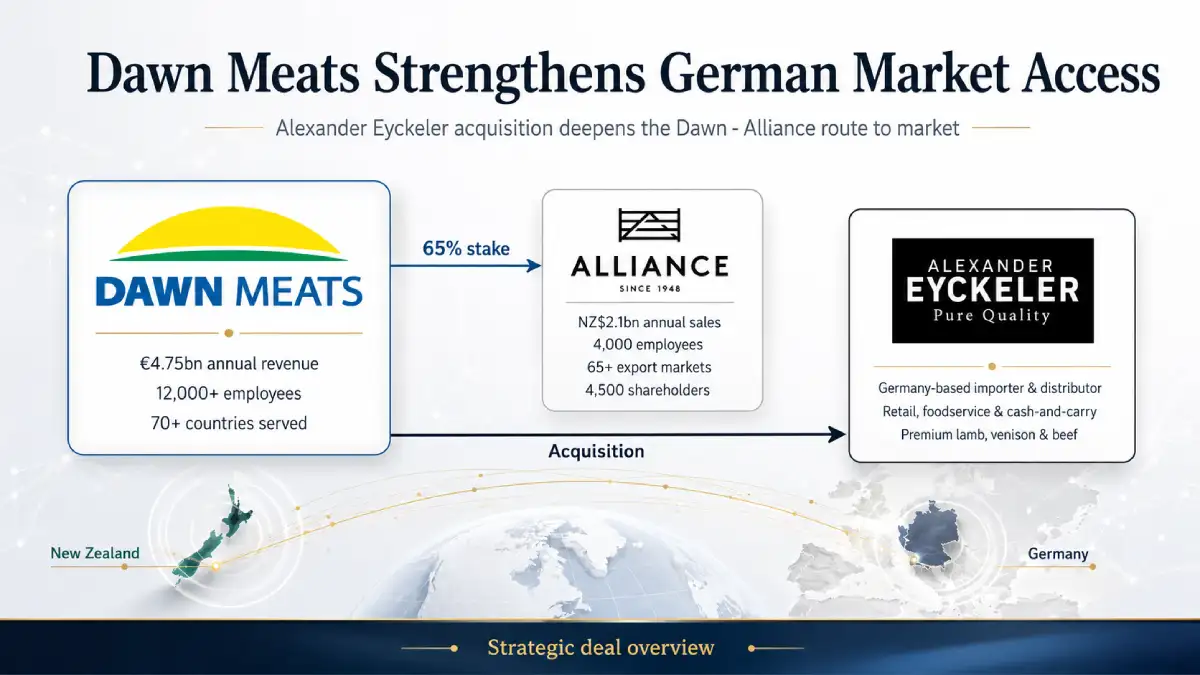
Dawn Meats’ acquisition of Alexander Eyckeler GmbH is not just another red meat sector transaction. On the surface, it is the purchase of a German importer and distributor. Strategically, it gives Dawn Meats a stronger in-market position in Germany, deepens its integration with Alliance Group in New Zealand, and strengthens control over an established premium lamb, mutton and venison route into one of Europe’s most important food markets. The deal value has not been disclosed, but reports state that the transaction has received the necessary regulatory approvals.
Niall Browne, CEO of Dawn Meats:
“This acquisition supports Dawn Meats’ ongoing integration with Alliance and strengthens our ability to serve customers in-market. It brings Dawn Meats closer to key customers in Germany, improves co-ordination across supply and logistics and provides continuity for the Eyckeler team and its customers.”
For anyone watching the European meat trade, the acquisition is worth attention because it brings together three important elements: Dawn Meats’ European processing scale, Alliance Group’s New Zealand grass-fed red meat supply, and Alexander Eyckeler’s long-standing German customer relationships. This is not simply about buying volume. It is about improving market access, customer proximity, logistics coordination and brand continuity in a premium product category.
Management Overview
Why Dawn Meats’ German Acquisition Matters Beyond the Headline
Dawn Meats’ acquisition of Alexander Eyckeler GmbH should be viewed as a strategic route-to-market move rather than a simple distributor purchase. It gives Dawn a stronger in-market position in Germany, while also supporting the integration of Alliance Group and its established New Zealand lamb, mutton and venison supply chain.
The important point for meat industry decision-makers is control. In premium red meat, competitive advantage is no longer created only by processing scale or export volume. It increasingly depends on how well a business can connect origin, brand, specification, logistics, market intelligence and direct customer relationships.
Alexander Eyckeler brings Dawn closer to German retail, foodservice and cash-and-carry customers. That matters because Germany is a sophisticated, demanding and price-aware market where trusted relationships, cold-chain reliability and product consistency are commercially decisive.
The deal also protects and strengthens the existing Ashley brand route into Germany. Rather than building a German platform from scratch, Dawn is acquiring a specialist business with established customer relationships, product knowledge and category credibility.
Strategic Signal
Major meat groups are increasingly looking beyond production capacity and towards stronger ownership of customer access, market intelligence and distribution channels.
Why Germany Matters
Germany is one of Europe’s most important meat markets, but it is also highly professional and demanding. Local relationships and service reliability can be as important as product quality.
Alliance Connection
The acquisition strengthens the commercial link between Alliance Group’s New Zealand supply and established German demand for Ashley lamb, mutton and venison.
Market Implication
This type of acquisition suggests that route-to-market control, brand continuity and logistics coordination are becoming central battlegrounds in premium meat supply.
Key management takeaways
- Route-to-market control is becoming more valuable as meat companies seek closer links between supply, logistics and customers.
- Specialist distributors remain strategically important because they hold local relationships, category knowledge and customer trust.
- The Alliance link gives the deal wider significance by connecting New Zealand red meat supply more directly with German market demand.
- Premium brands need more than origin stories; they need reliable execution, account management, product consistency and service continuity.
- Further consolidation may follow as major processors look to secure stronger positions in key European markets.
Management interpretation based on reported acquisition details, Dawn Meats’ Alliance Group integration, and Alexander Eyckeler’s established role in the German market.
What has happened?
Dawn Meats has acquired Alexander Eyckeler GmbH, a specialist German importer and distributor of high-quality meat products. Alexander Eyckeler is based in Erkrath, near Düsseldorf, and supplies retail, foodservice and cash-and-carry customers across Germany. The company is closely associated with Alliance Group’s Ashley lamb, mutton and venison brand, which Dawn Meats says holds a strong or dominant position in the German market.
The acquisition follows Dawn Meats’ majority investment in Alliance Group, the New Zealand red meat processor and exporter. Dawn completed the transaction for a 65% stake in Alliance in December 2025, with Alliance farmer-shareholders retaining a 35% shareholding. That earlier transaction was a major strategic step because it connected Dawn’s Ireland and UK operations with a significant Southern Hemisphere supply base.
The Alexander Eyckeler acquisition now gives that strategy a sharper European route to market. Germany is not just another export destination. It is a large, technically demanding and commercially mature market where trust, consistency, service and established trade relationships matter. By bringing Alexander Eyckeler into the group, Dawn is not starting from zero. It is taking over a business that already understands the customer base, the product expectations and the practical demands of chilled and frozen imported meat distribution.
Deal Snapshot
Dawn Meats Acquires Alexander Eyckeler GmbH
Dawn Meats’ acquisition of Alexander Eyckeler GmbH is more than a German distribution deal. It strengthens Dawn’s direct access to one of Europe’s most important meat markets, deepens the integration of its recent Alliance Group investment, and protects an established route to market for premium New Zealand lamb, mutton and venison.
Buyer
Dawn Meats
Family-owned Irish red meat group, established in County Waterford in 1980.
Scale
Around €4.75 billion annual revenue, more than 12,000 staff, and customers in over 70 countries.
Acquired Business
Alexander Eyckeler GmbH
German importer and distributor of chilled and frozen meat, based in Erkrath near Düsseldorf.
Market Reach
Supplies retail, foodservice and cash-and-carry customers across Germany.
Alliance Link
Alexander Eyckeler has long represented Alliance Group’s Ashley lamb, mutton and venison brand in Germany.
Strategic Context
The deal follows Dawn Meats’ acquisition of a 65% stake in Alliance Group, with farmer-shareholders retaining 35%.
Why it matters
This acquisition gives Dawn Meats a stronger in-market position in Germany while linking New Zealand supply, established premium brands and German customer relationships more closely together. For the wider meat sector, it highlights a growing trend: successful companies are not only competing on processing scale, but on tighter control of supply chains, logistics, brand positioning and customer access.
Sources: Dawn Meats company information; Agriland; Food Manufacture; ThinkBusiness. Deal value was not disclosed.
Why this deal matters
The simple version is this: Dawn Meats now has a more direct bridge between New Zealand supply and German demand.
That matters because imported premium meat is not only a procurement question. It is a coordination exercise. Chilled and frozen meat flows depend on timing, product specification, cold-chain reliability, brand confidence, market forecasting, account management and the ability to match supply with the needs of foodservice, retail and wholesale customers.
Niall Browne, chief executive of Dawn Meats, framed the acquisition in exactly those terms, saying the deal supports Dawn’s integration with Alliance and brings the business closer to key customers in Germany while improving supply and logistics coordination.
That language is important. It suggests this is less about short-term expansion and more about building a stronger operating platform. Dawn is not just buying a distributor. It is tightening the chain between farmer supply, branded product, European distribution and end-customer relationships.
Dawn Meats: the buyer behind the move
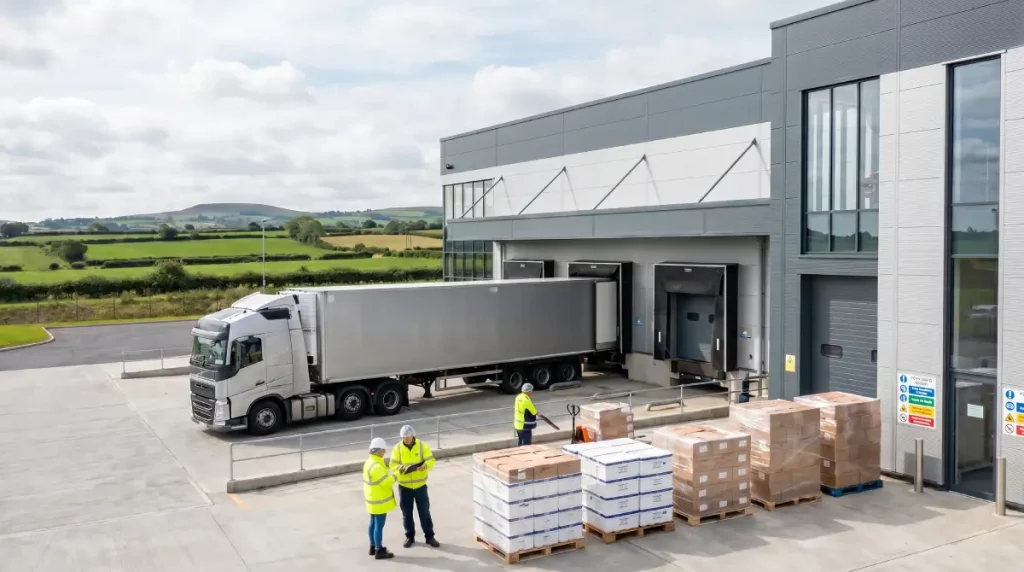
Dawn Meats is one of the major names in European red meat. Established in County Waterford in 1980, the company has grown into a family-owned international meat business supplying supermarket, manufacturing and foodservice customers. Dawn’s own media notes describe the group as generating around €4.75 billion in annual revenue, employing more than 12,000 people across 13 countries, and supplying customers in more than 70 countries.
The group operates as Dawn Meats in Ireland, Dunbia in the UK and, following the strategic partnership, Alliance in New Zealand. According to Dawn, the combined businesses now include 11 sites in Ireland, 13 in the UK and six in New Zealand, processing approximately 1.6 million cattle and 8 million sheep annually.
That scale is significant because the red meat sector is increasingly shaped by the ability to offer reliability across markets and seasons. Retailers, foodservice operators and manufacturers do not only want product. They want dependable supply, traceability, quality systems, specification control and commercial continuity. Dawn’s move into a majority position with Alliance, followed by the acquisition of Alexander Eyckeler, fits that wider pattern.
Alexander Eyckeler: the German specialist
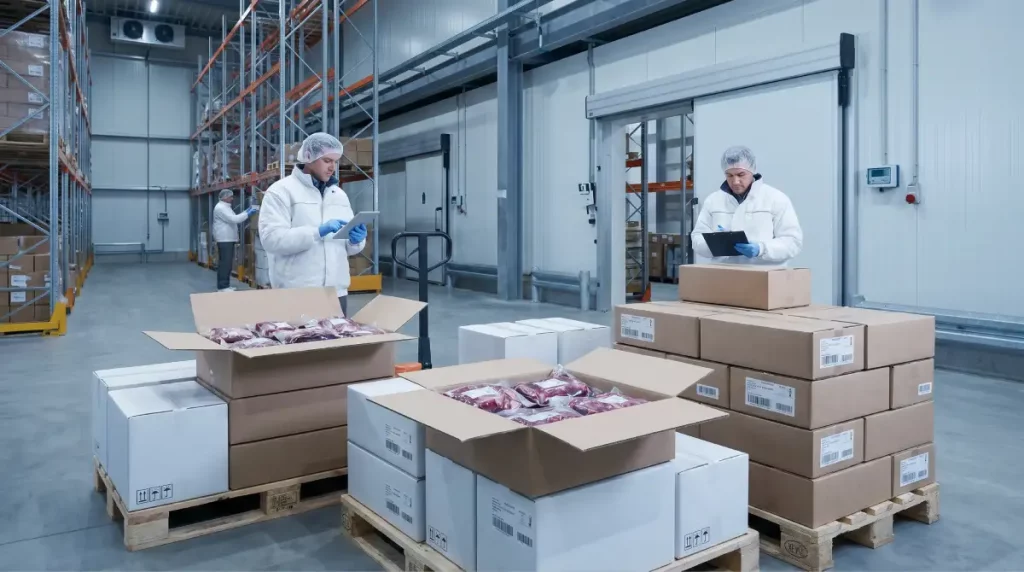
Alexander Eyckeler GmbH is not a broad commodity trader in the generic sense. Its own public positioning is built around premium imported meat, particularly lamb and venison from New Zealand and beef from countries including Argentina, Ireland and the United States. In a 2025 interview, managing director Markus Wagner described the company’s focus as high-quality lamb and venison from New Zealand, as well as premium beef from Argentina, Ireland and the USA, with Germany accounting for around 90% of sales.
The same interview gives useful detail about the company’s operating model. Wagner said the business imports approximately 4,500 tonnes of high-quality meat from New Zealand each year alone and serves large-scale consumer services, cash-and-carry markets and retail food stores. He also highlighted the role of private and partner brands, including Ashley, Argentine Beef, Irish Beef and US Beef.
There is one small detail to handle carefully. A publicly available interview states that ALEXANDER EYCKELER GmbH was founded in 2009, while several trade reports describe the company, team or brand representation as having a history of more than 25 years in imported meat and Ashley brand development. The safest interpretation is that the current company structure dates from 2009, while the people, relationships and brand-building activity behind it go back further.
The Ashley connection
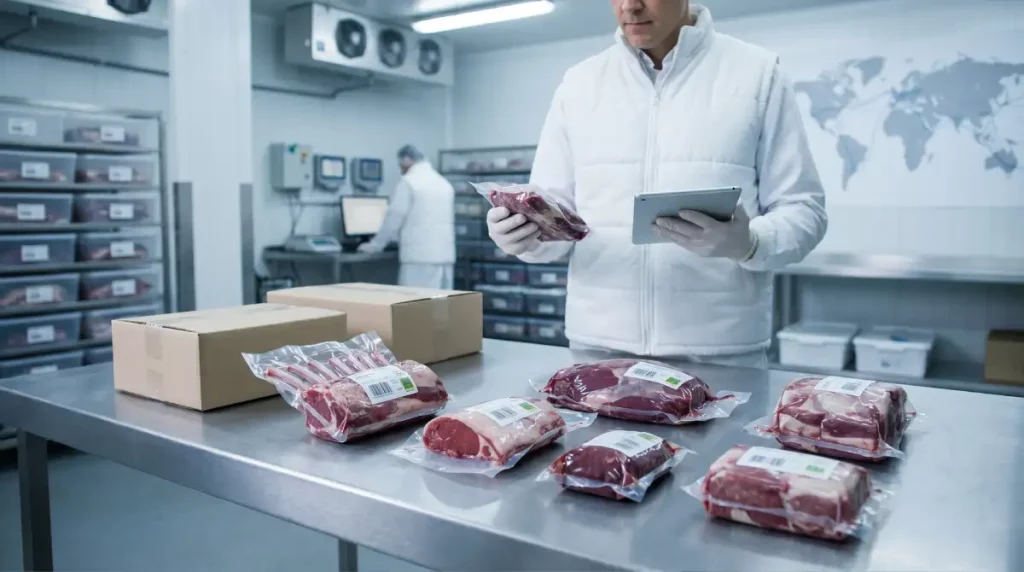
One of the most important parts of this transaction is the Ashley brand. Alexander Eyckeler has represented Alliance’s Ashley lamb, mutton and venison in Germany for many years, and trade reports describe the brand as having a strong or dominant position in the German market.
Ashley Lamb is positioned around New Zealand’s pasture-based farming system, year-round outdoor livestock production, natural feed and mild flavour. The brand’s product range includes fresh and frozen lamb cuts such as saddle, boneless leg, rump, loin, tenderloin, frenched rack, shanks, shoulder, goulash and mutton cuts.
Ashley Venison is also positioned around New Zealand farmed venison rather than wild European venison. Alexander Eyckeler’s own product material describes New Zealand farm venison as mild and consistent in flavour, especially relevant for gastronomy, and lists cuts such as boneless leg muscles, loin, tenderloin, frenched rack, shoulder, saddle and goulash.
For Dawn Meats, this matters because brands such as Ashley are not created overnight. They are built through repeated customer experience, chef confidence, distributor reliability and product consistency. Buying the German distributor therefore protects more than a route to market. It protects the commercial trust already attached to the brand.
Alliance Group: the New Zealand supply engine
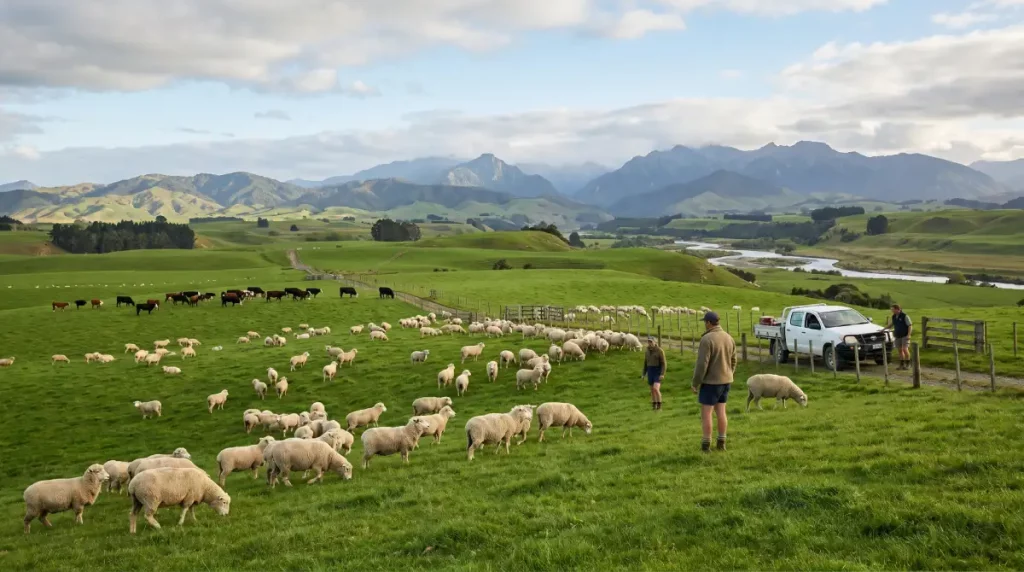
Alliance Group is one of New Zealand’s key red meat exporters. The company describes itself as a leading New Zealand red meat processor and exporter, producing premium grass-fed lamb, beef, venison and co-products for global customers. Its own company information states annual revenue of NZ$2.1 billion, sales into more than 65 countries, 4,500 shareholders, five global offices and approximately 4,000 employees.
The Dawn-Alliance transaction was significant not only because of its size, but because of what it gave both sides. Alliance gained capital and balance-sheet support after a difficult period, while Dawn gained a major Southern Hemisphere platform. Alliance said the completion of the deal would allow around NZ$188 million of investment proceeds to reduce short-term working capital, with further money allocated to capital programmes and farmer-shareholder distributions.
Alliance had recently returned to profit after two difficult years. For the year ending 30 September 2025, it recorded pre-tax profit of NZ$24.6 million on revenue of NZ$2.1 billion, compared with a pre-tax loss of NZ$120.8 million on revenue of NZ$1.8 billion the previous year. The company attributed the turnaround to a back-to-basics approach, stronger operational discipline, improved sales velocity, reduced inventory and better market diversification.
That backdrop makes the Alexander Eyckeler acquisition more meaningful. If Dawn’s Alliance investment was about scale and supply, the German acquisition is about execution. Strong supply only becomes commercially powerful when it is connected to the right customers through the right channels.
Germany as a strategic market
Germany is a demanding market for premium imported meat. It is price-conscious, highly regulated and commercially sophisticated. But it also has strong foodservice, wholesale and retail channels where quality-led imported lamb, venison and beef can hold a valuable position if the supply chain is reliable.
Alexander Eyckeler’s strength appears to be exactly there: specialist imported meat, premium positioning, close account management and established relationships with large-scale consumer services, cash-and-carry markets and retail food stores.
This matters because in-market knowledge is difficult to replicate from outside. A processor can have excellent product, but the final commercial success depends on matching that product to local expectations, customer formats, seasonal demand, menu trends, retail pack formats, wholesale requirements and price realities.
For Dawn, acquiring Alexander Eyckeler is therefore a shortcut to deeper German market intelligence. It provides a customer-facing layer that can feed information back into the wider Dawn-Alliance system: what customers are asking for, where demand is moving, which cuts are gaining traction, where price resistance appears and where premium positioning still holds.
The commercial logic: vertical coordination without losing specialist focus
The most interesting feature of this deal is that it brings Dawn closer to customers without necessarily turning the acquired business into a faceless group subsidiary. Markus Wagner, managing director of Alexander Eyckeler, has said the current team will continue to manage key accounts and oversee daily operations, with existing customer and supplier relationships remaining central to the company’s approach.
That continuity matters. In specialist meat distribution, relationships are not decoration. They are part of the product. Buyers, chefs and wholesalers rely on people who understand specification, substitution, availability, quality variations and practical service issues. A change of ownership can create nervousness if customers fear disruption. Dawn’s message appears to be the opposite: ownership changes, but service continuity remains.
If executed well, this creates the best of both worlds. Alexander Eyckeler keeps its specialist German market role, while Dawn gains better oversight, coordination and strategic alignment between New Zealand supply, European processing strength and German customer demand.
What the deal says about the future of the meat trade
The acquisition reflects a wider direction in the meat industry: control of the route to market is becoming as important as processing scale.
For years, many processors have competed on livestock access, plant efficiency, export reach and customer relationships. Those things still matter. But the next layer of competitive advantage is integration: the ability to connect origin, processing, brand, logistics, data, customer insight and end-market distribution into one coherent system.
This is especially true for premium red meat. Lamb, mutton and venison from New Zealand are not low-involvement commodity lines. They require confidence in origin, consistency, cold-chain performance and brand reputation. When a major processor buys into the supply base and then also strengthens the in-market distributor layer, it is building a more resilient commercial chain.
For UK and European meat businesses, the lesson is clear. The companies that win will not only be those that produce or source good meat. They will be those that can explain it, position it, supply it reliably and stay close enough to the market to understand what customers will need next.
What to watch next
The first question is whether Dawn uses Alexander Eyckeler mainly as a continuity platform or whether it gradually broadens the business’s role in Germany. Given Dawn’s scale across Ireland, the UK and New Zealand, there may be opportunities to use the German customer base for a wider product portfolio over time. But the immediate logic appears to be protecting and strengthening the Alliance-Ashley route to market rather than disrupting it.
The second question is whether the deal leads to more acquisitions of specialist distributors in other European markets. If Dawn sees clear value in owning more of the customer-facing layer, Germany may not be the final move.
The third question is how the Alliance integration develops. Dawn has said the Alliance partnership creates a year-round supply opportunity between the Northern and Southern Hemispheres. The acquisition of a German importer makes that strategy more practical by giving the group stronger direct access to a key European market.
The bigger picture
This deal is not dramatic because of the disclosed numbers. There are no headline-grabbing valuation figures, and the acquisition price has not been made public. Its importance lies in the structure.
Dawn Meats has taken a majority position in a major New Zealand red meat exporter. It has then acquired a German specialist that already manages an important part of that New Zealand product’s route into Germany. That is a strategic chain being tightened: supply, brand, market access and customer relationships moving closer together.
For the European meat sector, this is the kind of transaction that deserves more than a short news paragraph. It shows where competitive advantage is moving. Not just bigger factories. Not just more exports. Not just more brands.
The strongest players are building systems.
And in a market where reliability, traceability, service and customer confidence matter as much as price, that system-building may prove to be the real story behind Dawn Meats’ move into Alexander Eyckeler.